

At Volkswagen, 21,500 managers will soon be 16,000. Deutsche Bahn, BMW and Bayer are cutting management too, and since 2019 Germany has lost 341,500 industrial jobs. This time the cuts don’t start on the shop floor. They start on the floors above it: middle management, and more and more often the top.
If you’re around 50 and looking at one of those lists right now, whether you’re the one signing it or the one whose name is on it, the first thing you hear is a threat. I mostly hear an invitation. For leaders over 50, this may be the biggest chance in decades to reinvent themselves.
Why now, and why at 50? Harvard’s Arthur Brooks describes two curves. Fluid intelligence, the fast, raw processing power, peaks early. Crystallized intelligence, meaning experience, judgment and the ability to see patterns and read people, keeps growing well into your fifties and stays high for a long time. In the age of AI, that’s exactly the edge no tool can copy. I’m 58, and I feel more like I’m taking off than winding down.
Let me tell it through two men I’ve composed from many conversations. Monday, just after seven. Frank, 54, CEO for three years, signs a list with 380 names on the fourth floor and tells himself: I can handle this. At the same moment, down at the turnstile, Stefan’s badge beeps red. After 22 years with the company, his name is on page eleven.
Both start by doing what almost everyone does. They work harder in the old pattern, hope someone will rescue them, or shrink their ambition until it fits the situation. Then next year looks like this one, only with less energy.
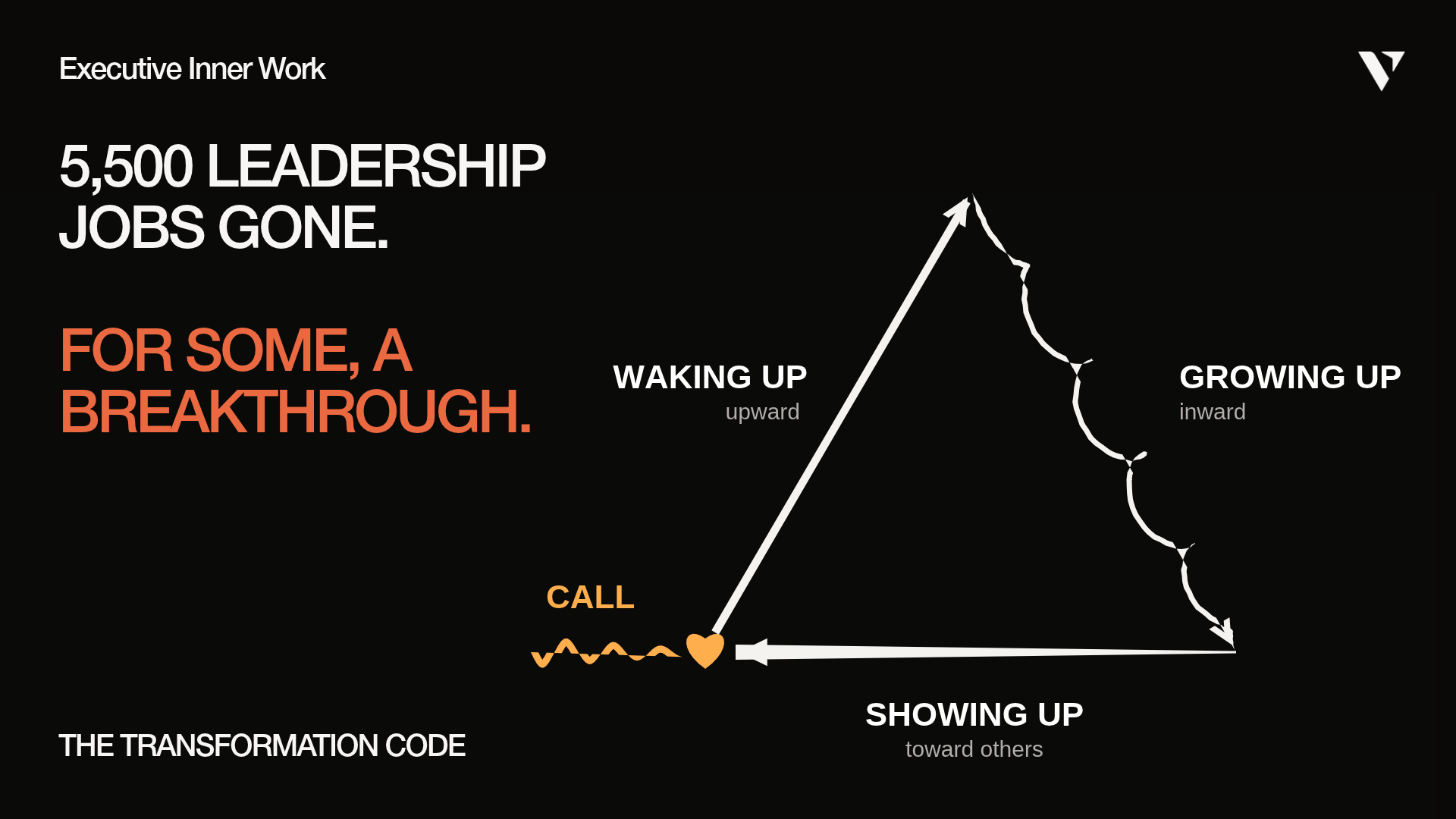
There’s a fourth way, and it’s ancient. Joseph Campbell found it in myths from all over the world: the hero’s journey. In my work on The Transformation Code, it has four steps.
The Call. You read the crisis as an invitation and ask yourself: what is this challenge inviting me into? In that moment you move from victim of the situation to author of your story.
Waking Up, upward. Waking up is opening up. You learn to be amazed again, seek out new experiences, let yourself be inspired and find flow. In small doses, that’s daily rituals and moments where the challenge sits about four percent above what you can safely do, because that’s where flow happens. In big doses, it’s a summit: a few days away, with good guidance, and from up there you suddenly see where you come from and where you could go.
Growing Up, inward. You make sense of what you saw up there, look your fears in the eye and let go of what no longer carries you. After 50, growth rarely means piling more on. Mostly it means making the backpack lighter.
Showing Up, toward others. You bring all of it back to your team, your company and your family, from me to we. That’s usually the hardest part, because the old system pushes back, and that’s exactly why it’s better not to walk it alone.
Three years later, Frank sleeps through the night again, and Stefan looks forward to being asked what he does. One day they sit at the same table, and Stefan is guiding young plant managers through Frank’s restructuring. Among the leaders who train with us, we measure around 59 percent less stress. The wave hits everyone. You choose the direction.
Your number for tonight. Give each direction a score from 1 to 5. When did you last feel amazed, experience something truly new or lose yourself in flow in the past six months (Waking Up)? How honestly have you looked at what you want to let go of (Growing Up)? How much of it reaches your people (Showing Up)? Wherever you’re below 4, your next breakthrough is waiting.
The exercise, 20 minutes. Take a sheet of paper and draw three columns: what I take with me, what I let go of, what I learn anew. Write one or two things in each column, and underneath, one sentence that starts with “From now on, I lead …”. Then sign it. Frank signed a list that Monday. This signature belongs only to you.
I’d love to hear which direction is calling you right now. Just hit reply.
From the heart,
Achim
P.S. If this was useful, forward it to one leader who is looking at a list right now.