

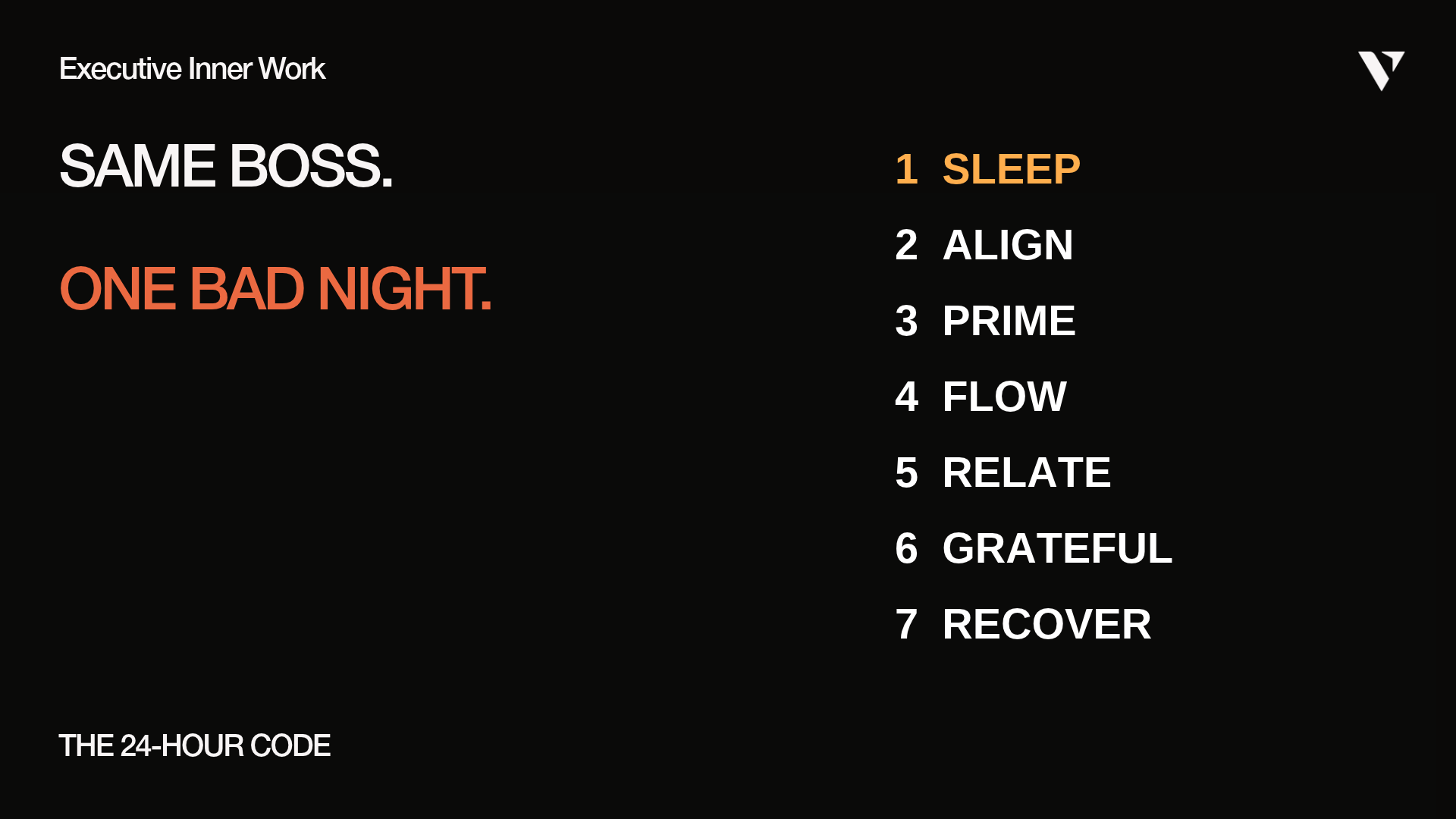
At the University of Washington, Christopher Barnes ran a simple experiment. People prepared an inspiring speech and delivered it on camera. Half of them had slept normally, the other half had lost about two hours of sleep. Judges who had no idea who was who rated the tired speakers as clearly less charismatic. Same person, same words, one bad night.
I think about that study often, because it describes something I see in leaders in every country I work in. We treat the day as the unit of leadership: the meeting, the decision, the conversation. But by the time the day begins, half of it is already decided.
That’s why I condensed the daily side of The Transformation Code into seven steps that follow a single day. I call it the 24-Hour Code.
Step 1: SLEEP. The foundation.
Sleep is where your brain resets its emotional regulation. Without it, you can still think, but it gets much harder to project calm and energy, and Barnes’s later studies found that tired leaders are also more often short with their teams. Jeff Bezos has said for years that he protects eight hours, because, in his words, “I think better, I have more energy, my mood is better.” Tonight, before bed, write down the three things your mind wants to keep working on. I call it the night-watchman note: the paper keeps watch, so you don’t have to.
Step 2: ALIGN. Before the phone.
Breathing six seconds in and six seconds out slows your heart rhythm and activates the vagus nerve, the brake of your nervous system. Five minutes of it brings the five levels we work with, your nervous system, your emotions, your identity, your thinking and your actions, onto one line. Tomorrow morning, do five minutes of six in, six out before you touch your phone.
Step 3: PRIME. Before the moment that counts.
No athlete walks onto the field cold, yet most leaders walk into the board meeting straight out of their inbox. Two minutes before your most important meeting tomorrow, stand up, breathe out slowly and ask yourself one question: what is the one thing this meeting needs from me?
Step 4: FLOW. One block that matters.
Flow research shows that we drop into deep focus when the challenge sits just slightly above what we can comfortably do, roughly four percent. That needs time without interruption. Protect one 90-minute block tomorrow for the one thing that moves your business, with your phone in another room.
Step 5: RELATE. One person, one honest sentence.
Under pressure, leaders tend to carry things alone, and carrying alone is expensive for the nervous system. Tomorrow, tell one person what you’re actually wrestling with. One honest sentence is enough.
Step 6: GRATEFUL. Back to the heart.
A brain under pressure scans for what’s missing. That’s useful at noon and costly at night. Before sleep, take three slow breaths, six in, six out, name one thing from today you’re genuinely grateful for, and let yourself feel it in your chest for a moment.
Step 7: RECOVER. The transition.
Sabine Sonnentag in Mannheim has studied recovery for more than twenty years. Her research shows that people who mentally switch off from work in the evening feel better and less fatigued, especially after high-pressure days, and start the next morning calmer and more awake. I learned the same thing on the basketball court: muscles don’t grow during training, they grow during recovery. Athletes call it supercompensation. On your way home tomorrow, take three minutes in the car or in front of your door. Breathe six in, eight out, and decide what stays at work tonight.
And then the circle starts again with sleep.
Among the leaders who train with us, we measure around 59 percent less stress. It rarely comes from one big change. It comes from a day that is built differently, from the night before to the evening after.
You don’t need all seven tomorrow. Pick the one where you felt a slight tightness while reading. That’s usually the one that matters most right now.
I’d love to know which one it was. Leave a comment or just hit reply.
From the heart,
Achim